
A self-guided W Trek costs anywhere from roughly $500 USD for a camper carrying their own gear to $1,500 and beyond for refugio beds with full board, before guided packages push past $2,500. The spread is that wide because almost every cost on the trail is a choice: where you sleep, what you eat, and how much you carry.
This page lists the actual operator prices for the 2026/27 season, broken down by type, so you can total your own trek before you book anything. All figures below were compiled in July 2026 from the operators’ current rates. For the wider route and planning overview, see our W Trek planning guide.
For a broader look at how these expenses fit into a larger trip through Chile and Argentina, see our comprehensive guide to Patagonia travel costs.
Total Budget Breakdown: Three Real-World Scenarios
Before we go into the individual price breakdown for accommodation, food, and more, here is an approximate breakdown of the total W Trek, depending on your comfort levels.
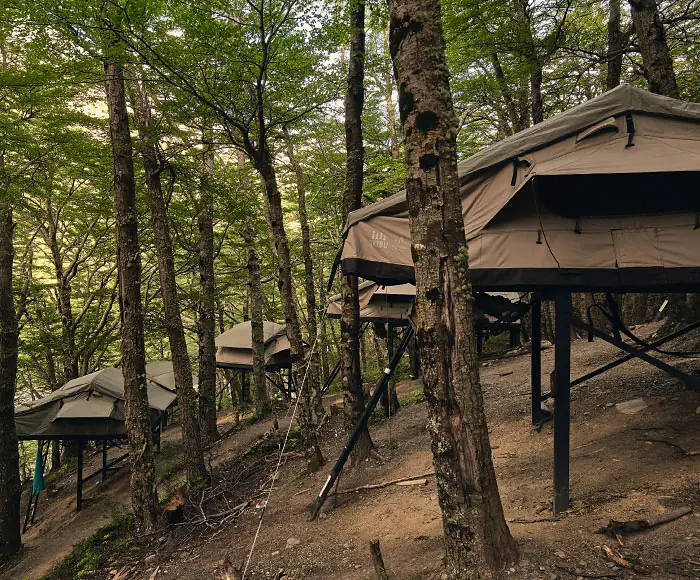
- Accommodation: Own tent, ground pitches ($206 solo) | Equipped camping, shared ($540) | Refugio beds ($690)
- Food: Self-catering from Natales ($60 - $100) | $150 | Full Board both companies ($500)
- Transport: Bus and catamaran ($60) | Bus and catamaran ($60) | Bus and catamaran ($60)
- Park pass: CLP 48,500 ($50) | CLP 48,500 ($50) | CLP 48,500 ($50)
- Estimated Total: $400 - $550 USD | $800 USD (based on 2 people sharing) | $1,300 - $1,600 USD
For most travelers, the Comfort Hiker model offers the best balance of Patagonian atmosphere and physical recovery without the four-figure food bill.
The shared equipped-camping example assumes a five-hiking-day, four-trail-night West to East trek: one night each at Grey, Paine Grande, Francés/Cuernos, and Chileno. Puerto Natales stays, flights, and optional activities are separate. It includes two Las Torres equipped-camping nights at $160 per person and two Vertice nights at $110 per person, including a pillow, plus $150 for food, $60 for transport, and a $50 park pass.
Additionally, one of the big costs of the W Trek can be relying on a third-party or tour operator to book the trek for you. To help bypass this, we’ve laid out a step-by-step guide to booking the W Trek yourself, explaining how to line up campsites and refugios across both operators. If you would prefer the arrangements handled for you, compare guided and self-guided W Trek packages.
Park Entry: The Pass Every Hiker Needs
Every visitor buys a park pass in advance through the official portal at pasesparques.cl. The W Trek always spans multiple days, so you need the multi-day pass.
| Pass | Price |
|---|---|
| Multi-day pass (required for the W Trek) | CLP 48,500 (approx. $50 USD) |
| 1-day pass (day trips only) | CLP 32,400 (approx. $34 USD) |
Buy your pass online at least 24 hours before arrival. The park entrance does not sell permits at the gate, and the cellular signal is too weak to rely on booking when you get there.
It is also mandatory to have confirmed accommodation for every night you spend inside the park. Rangers may ask to see your Vertice and Las Torres reservation vouchers before letting you onto the trailheads.
Transport: Getting to and Around the Park
The journey from Puerto Natales involves a short chain of separate tickets. None of them are expensive, and none of them tend to sell out, but we recommend booking at least a few days in advance just to be certain.
| Leg | Price |
|---|---|
| Bus Sur, Puerto Natales to the park | CLP 15,000 each way (approx. $16) |
| Catamaran Pehoé, Pudeto to Paine Grande | approx. CLP 28,000 (approx. $29) |
| Laguna Amarga shuttle, park entrance to Las Torres sector | approx. CLP 5,000 (approx. $5) |
Book the bus through Bus Sur; the typical departure is around 6:45 to 7:00 am. Book the catamaran through the official Catamaran Pehoé site, where the usual crossing is the 10:30 sailing. The Laguna Amarga shuttle is a short hop for the eastern trailhead.
Which way you ride the catamaran depends on your direction. Starting in the west, you take it on the way in, straight after the morning bus. Starting in the east, you take it on the way out.
Accommodation: What Each Company Charges
Accommodation is the largest variable in your budget. The trail’s sites are split between two companies: Las Torres runs the east and centre (Chileno, Cuernos, Francés, Central, Norte, Serón) and Vertice runs the west (Grey, Paine Grande, plus Dickson and Los Perros on the O Circuit). Their pricing models are very different, so we list them separately. How the two chain together, and the order to book them in, is covered in our step-by-step booking guide.
Booking 9 or more months in advance, doing it yourself across both operator sites is manageable. Inside that window availability fragments, and you end up juggling tabs trying to line up consecutive nights in the right order. That is when an aggregator like Torres Hike, which searches both companies and charges a fee, becomes worth considering.
Las Torres accommodation (per night, USD)
| Option | Price |
|---|---|
| Single bed in shared refugio room | $230 |
| Fully equipped camping (single) | $290 |
| Fully equipped camping (double) | $320 |
| Semi-equipped camping (single) | $220 |
| Semi-equipped camping (double) | $240 |
| Campsite on ground (single, 1 person) | $90 |
| Campsite on ground (double, 2 people) | $100 |
The pattern to notice: doubles cost little more than singles, so couples and pairs sharing pay far less per person. A fully equipped double works out at $160 each, against $290 for one person in the same tent.
Vertice accommodation (per night, USD)
| Option | Price |
|---|---|
| Single bed (mattress cover, pillow and pillowcase only) | $66 |
| Bunk bed, fully equipped (sheets, pillow, blanket) | $114 |
| Camping site (per person) | $13 |
| 4-season tent rental (max 2 people) | $58 |
| Sleeping bag rental (per person) | $38 |
| High-density foam mattress (per person) | $16 |
| Towel rental | $14 |
| Pillow (camping only) | $14 |
Vertice is dramatically cheaper than Las Torres at the budget end: a $13 pitch against $90. The catch is that Vertice only covers the western half of the trail, so every W Trek itinerary spends at least two nights on Las Torres pricing.
To see the specific facilities and bunk configurations at each site, refer to our detailed guides on W Trek camping and W Trek refugios.
Food: Meal Plans, Individual Meals, and Self-Catering
You choose meals at the time of booking, and again the two companies price differently. All prices are per person, in USD.
Las Torres meals
| Option | Price |
|---|---|
| Full Board (dinner, breakfast, box lunch) | $140 per day |
| Half Board (dinner, breakfast) | $90 |
| Breakfast (bread, eggs, marmalade, cereal, tea or coffee) | $40 |
| Dinner (soup starter, main, water, bread, butter) | $70 |
| Box Lunch (sandwich, cereal bar, dried fruits) | $40 |
Las Torres includes a free welcome drink, and sunscreen is often available on site for free.
Vertice meals
| Option | Price |
|---|---|
| Full Board (dinner, breakfast, lunch or box lunch) | $110 |
| Half Board (dinner, breakfast) | $76 |
| Breakfast | $34 |
| Lunch or Box Lunch | $36 |
| Dinner | $53 |
How meals are served at each refugio
| Refugio | Style | Seating |
|---|---|---|
| Grey | Buffet | Open |
| Paine Grande | Buffet | Open |
| Francés | Plated, coursed out | Open |
| Cuernos | Plated, coursed out | Assigned |
| Chileno | Plated, coursed out | Assigned |
Self-catering
Self-catering is the only way to keep food under $20 USD per day, and it works everywhere on the trail if the stove-free nights are planned around hot-water meals. Cooking is allowed only in designated shelters: the operators list them at Grey, Paine Grande, Central and Francés, but not at Cuernos or Chileno. It is never allowed inside refugios, inside tents or in the open. Chileno supplies hot water for porridge, couscous, instant noodles and freeze-dried meals; boiling water is also commonly reported at Cuernos, but reconfirm it on arrival. Do not rely on microwave access anywhere.
Use designated drinking-water taps where staff confirm the water is potable. Do not assume that even clear, fast-flowing streams are safe: the CDC advises treating untreated water when you are unsure, by boiling it or filtering and disinfecting it according to the product instructions.
On the Trail: The Small Costs and Useful Free Things
Cash is barely needed. If everything is pre-booked, all campsites accept credit cards, including for à la carte food. The only common cash use is the bus from the Welcome Center back to the pickup point, and even that can be pre-booked.
Refugio kitchens and shops. All sites have small shops for basic snacks and drinks. Vertice kitchens serve à la carte food (burgers, pizzas) from 14:00 to 17:00 and 18:00 to 20:00, outside the set meal hours of breakfast 06:30 to 09:00, lunch 12:00 to 14:00 and dinner 18:30 to 21:00. Expect around $20 for a personal pizza and $8 to $10 for a beer.
Electricity. Vertice sites have 220V sockets in rooms and guest living areas, with power on from 06:00 to midnight. There is no electricity overnight, so charge in the evening.
WiFi. Vertice gives 30 minutes free at your first stay in its sector. Further access there, and access elsewhere on the trail, is paid.
Bag drops and storage. Backpacks can be left at Italiano camp before the French Valley climb and at Chileno before the Base Towers ascent; this is normal and expected. Leaving bags and charging electronics at campsites is safe, standard practice. Vertice also stores bags for CLP 4,000 per pack, useful if you reach Grey before check-in opens on day one.
Puerto Natales: Budget the Prep Days Too
If possible, allow two preparation days in Puerto Natales before the trek, especially if you are self-catering. Shopping rounds, packing and equipment rental can take a full day. One overnight can work if time is tight, but arrive with a food list so you can use your time intentionally.
- Groceries. The town has a couple of decent-sized supermarkets, and pricing is essentially the same as Santiago, so there is no need to bring food from home. The specialist hiking shops sell freeze dried meals: expensive, but a nice treat at a fraction of refugio dinner prices.
- Gear rental. Rental Natales is solid, with full pricing published online. Vertice also rents tents, bags and mattresses on site at the per-night rates in the table above.
- Luggage storage. Most hostels store bags free while you trek. Dedicated services like Erratic Rock charge.
If the Comfort Trekker price point looks acceptable, it is worth checking whether a fully organized tour adds enough value through logistics and guiding to justify the step up. Compare the options in our guide to guided vs. self-guided W Treks and the current W Trek guided and self-guided packages.
Money-Saving Tips for the W Trek
1. Book 9+ months in advance. The cheapest sites, especially Vertice’s $13 pitches at Grey and Paine Grande, go first. Booking early also keeps the whole process manageable across the two operator websites; inside that window you are picking through fragmented availability.
2. Share what can be shared. The single-to-double gap in the Las Torres tables is the biggest lever on the page: a fully equipped double splits to $160 each against $290 solo. At Vertice, the tent rental is shared between two people; the pitch, sleeping bag, mattress, and pillow are charged per person. Solo and unwilling to share? Take a refugio bunk, which is priced per bed.
3. Flex on food before accommodation. Half board instead of full saves $34 to $50 per day, and carrying a freeze dried meal for the stove-free nights at Chileno or Cuernos costs a fraction of a $70 plated dinner.
4. Carry your own trail snacks. Refugio shop prices reflect the supply chain: around $20 for a pizza and $8 to $10 for a beer. Chocolate, nuts and bars bought at a Puerto Natales supermarket cost the same as anywhere in Chile and save real money over five days.
5. Leverage the shoulder season. October and April bring more availability at the cheap end, so you are far more likely to find a basic pitch than in January. For the trade-offs, see the best time to hike the W Trek.
Related Planning Guides
To continue your preparation for the W Trek, explore our detailed logistical resources:
FAQ
- QUESTION: Is the W Trek in Torres del Paine expensive?
- ANSWER: The W Trek is a mid-to-high cost hike compared to other global trails, with 2026 budgets ranging from around $400 to $550 for independent campers to $1,300 to $1,600 for refugio beds with full board, and over $2,500 for guided treks.
- QUESTION: Do I need cash on the Torres del Paine W Trek?
- ANSWER: Very little. All campsites accept credit cards, including for à la carte food, if your trek is pre-booked. The only common cash use is the short bus from the Welcome Center back to the pickup point, and even that can be pre-booked.
- QUESTION: How much does a meal cost on the W Trek?
- ANSWER: Full board costs $110 per day at Vertice sites and $140 per day at Las Torres sites. Individual dinners run $53 to $70, and breakfasts $34 to $40.
- QUESTION: How much does it cost to camp on the W Trek?
- ANSWER: A basic pitch with your own gear costs $13 per person per night at Vertice sites (Grey, Paine Grande) and $90 to $100 per night at Las Torres sites, so every itinerary mixes cheap and expensive nights.
- QUESTION: Can I do the W Trek for free?
- ANSWER: No. Park entry costs CLP 48,500 (around $50 USD) for the multi-day pass, and every campsite on the trail is privately managed with nightly fees.
- QUESTION: Is water free on the W Trek?
- ANSWER: Designated drinking-water taps confirmed potable by staff are the simplest option. Do not assume that an untreated stream is safe: if you are unsure, boil the water or filter and disinfect it according to the product instructions.
- QUESTION: What is the cheapest month to do the W Trek?
- ANSWER: The shoulder months of October and April offer more availability at the cheapest campsites compared to the peak December to February season, which is where the real saving lies.