
Perito Moreno vs Grey Glacier: Which One Should You Visit?
Perito Moreno is the best choice for travelers seeking a theatrical, easily accessible spectacle of calving ice, while Grey Glacier is the superior option for those wanting a remote, immersive wilderness experience within a multi-day trek. While both are massive outflows of the Southern Patagonian Ice Field, the way you interact with them, the cost of the journey, and the physical effort required are fundamentally different.
Choosing between them often dictates the entire structure of a Patagonia itinerary. Perito Moreno is a standalone destination that can be experienced in a few hours from a comfortable base in El Calafate, Argentina. Grey Glacier, located in Chile’s Torres del Paine National Park, is a prize usually won after days of hiking, though boat access has made it more reachable for non-trekkers.
Glacier Comparison at a Glance
- Location: Perito Moreno (Argentina) vs. Grey Glacier (Chile)
- Primary Hub: El Calafate (AR) vs. Puerto Natales (CL)
- Accessibility: High (Boardwalks) vs. Moderate (Boat or Trek)
- Status: Historically Stable (Perito Moreno) vs. Retreating (Grey)
- Top Activity: Ice Trekking (PM) vs. Kayaking (Grey)
- Ideal Visit: 1 Day (PM) vs. 2-3 Days (Grey)
Both glaciers offer the signature deep-blue ice and jagged crevasses that define the region, but they serve different travel styles. If your priority is seeing massive chunks of ice crash into the water from a front-row seat, Argentina has the advantage. If you want to feel the scale of the ice field while surrounded by granite peaks and sub-antarctic forests, Chile is the winner.
Quick Comparison: Perito Moreno vs. Grey Glacier
To decide which glacier fits your trip, you must first determine how much time you are willing to spend in transit and how much physical activity you want to undertake. Perito Moreno is famous for its constant movement and frequent calving, whereas Grey Glacier is known for its dramatic backdrop and the floating blue icebergs that clog the shores of Lago Grey.
- Access Method: Steel boardwalks and short boat rides vs. Multi-day trek or a 3-hour catamaran trip.
- Main Activity: Viewing from walkways, Minitrekking, and Big Ice treks vs. Kayaking among icebergs, ice hiking, and W Trek viewpoints.
- Vibe: Theatrical, powerful, and busy vs. Serene, remote, and rugged.
- Logistics: 1.5-hour drive from El Calafate vs. 2-hour drive from Puerto Natales plus a boat or trek.
Choose Perito Moreno for the spectacle of calving ice and easy access; choose Grey Glacier for wilderness immersion and adventure sports.
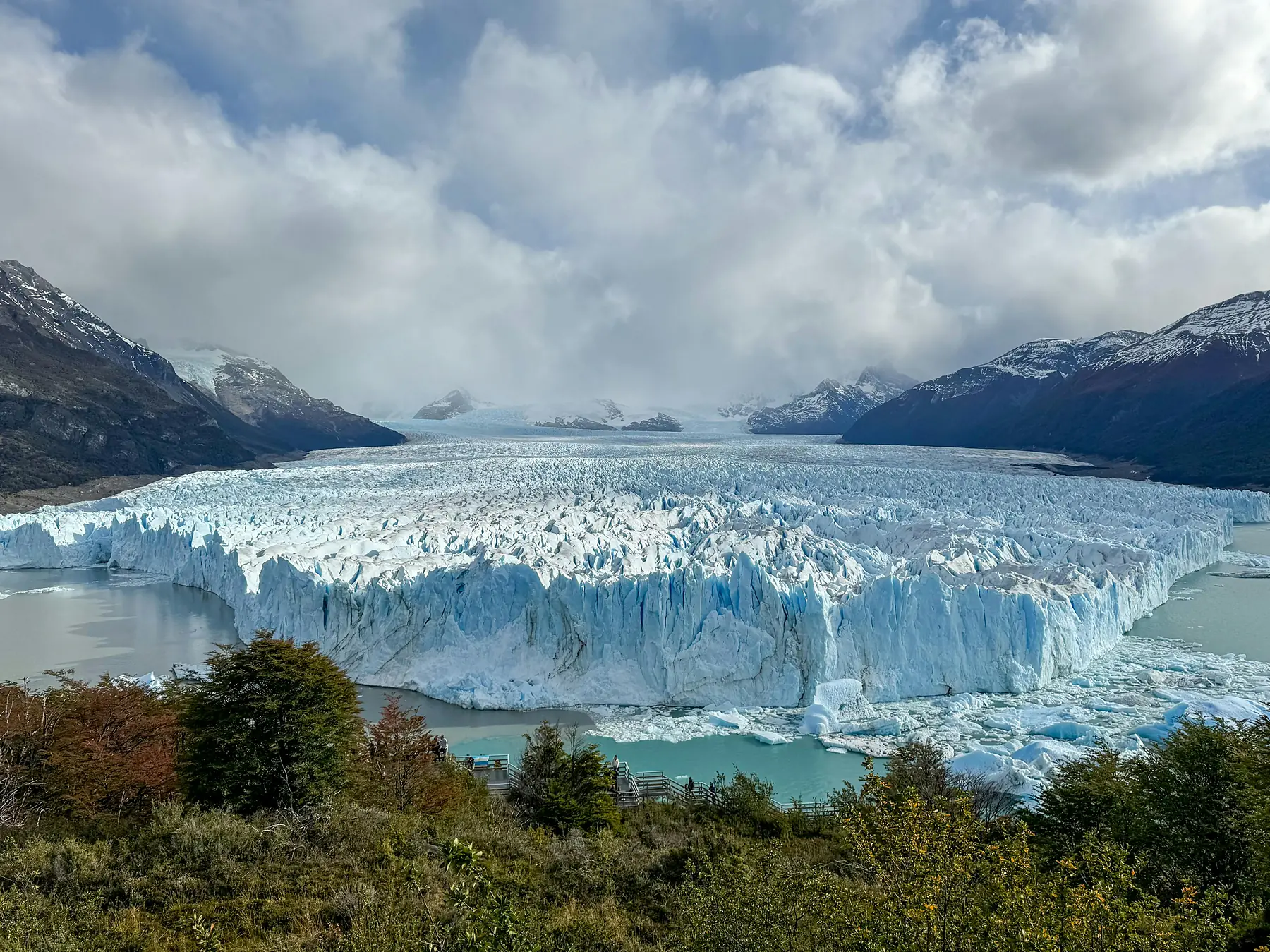
The main difference lies in the perspective. At Perito Moreno, you look at the glacier from a series of elevated platforms that provide a panoramic view of the 5-kilometer-wide face. At Grey Glacier, you are often looking down on the ice from the hiking trail or paddling alongside it in a kayak, providing a much more intimate, though less panoramic, experience.
Perito Moreno: The Accessible Icon of Argentina
Perito Moreno is widely considered the most impressive glacier in the world because of its unique accessibility and active nature. For decades, it was famous as one of the world’s only advancing glaciers. While recent scientific data (as of 2025) shows it has begun a period of retreat and thinning, it remains remarkably stable compared to its neighbors. This stability creates immense pressure, leading to frequent calving events where house-sized blocks of ice shear off the face and thunder into the Canal de los Témpanos.
The centerpiece of the experience is the boardwalk system within Los Glaciares National Park. These steel walkways extend for several kilometers, offering multiple levels of viewing. Because the glacier sits directly across from a peninsula, you can stand less than 500 meters from the ice wall, which rises up to 70 meters above the water line.
The best light for photography at Perito Moreno is in the mid-to-late afternoon. As the sun moves, it illuminates the deep blue crevasses of the face, and the rising temperatures increase the likelihood of seeing a major calving event.
Accessibility is the hallmark of this site. Located approximately 80km from El Calafate, the glacier is reachable via paved roads. You can take a public bus, join a tour, or drive a rental car and be back in town for a steak dinner by evening. This makes it the logical choice for families, travelers with limited mobility, or those on a tight schedule who only have one day to dedicate to the ice.
To explore the specific tours and logistics of the Argentine giant, see our dedicated guide.
Grey Glacier: The Remote Jewel of Torres del Paine
Grey Glacier is the northern terminus of the famous W Trek in Torres del Paine National Park. It lacks the convenient boardwalks of its Argentine neighbor, but it compensates with a sense of isolation and a stunning geological setting. The glacier spills out from the ice field and splits around a central nunatak (a rocky island), creating two distinct faces that are best viewed from the hiking trail or the deck of a boat.
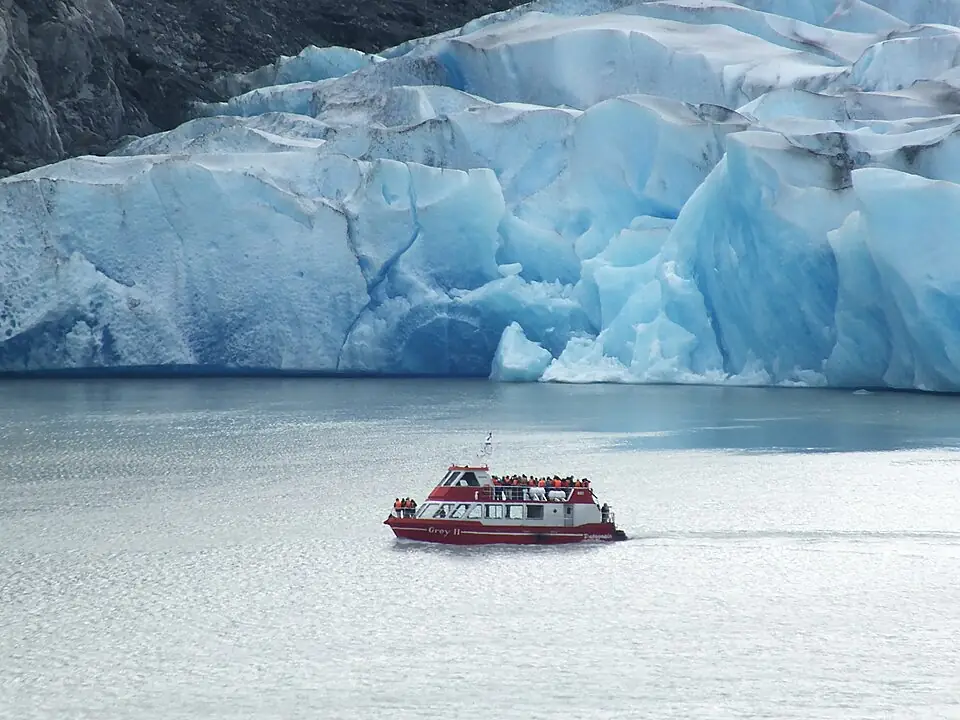
For those not embarking on a multi-day trek, the primary way to see the glacier is the Grey III boat navigation. This catamaran departs from the southern end of Lago Grey and takes passengers close to the face of the glacier. The journey itself is spectacular, passing through waters often filled with massive, electric-blue icebergs that have drifted away from the main ice mass.
The aesthetic of Grey Glacier is defined by “rock flour”—fine glacial sediment that gives the lake its namesake grey color. This creates a stark, moody contrast with the bright blue of the ice and the dark, jagged peaks of the Paine Massif. It feels like a true wilderness outpost, far removed from the paved roads and gift shops found near Perito Moreno.
If you are planning to incorporate this into a larger Chilean adventure, our full guide covers the trail conditions and boat schedules.
Activities Compared: Ice Trekking and Kayaking
Both glaciers offer the chance to get off the sidelines and onto the ice, but the logistics of these adventures differ significantly. If your goal is to physically walk on a glacier, Perito Moreno is generally the more straightforward option, while Grey Glacier offers more varied water-based adventures.
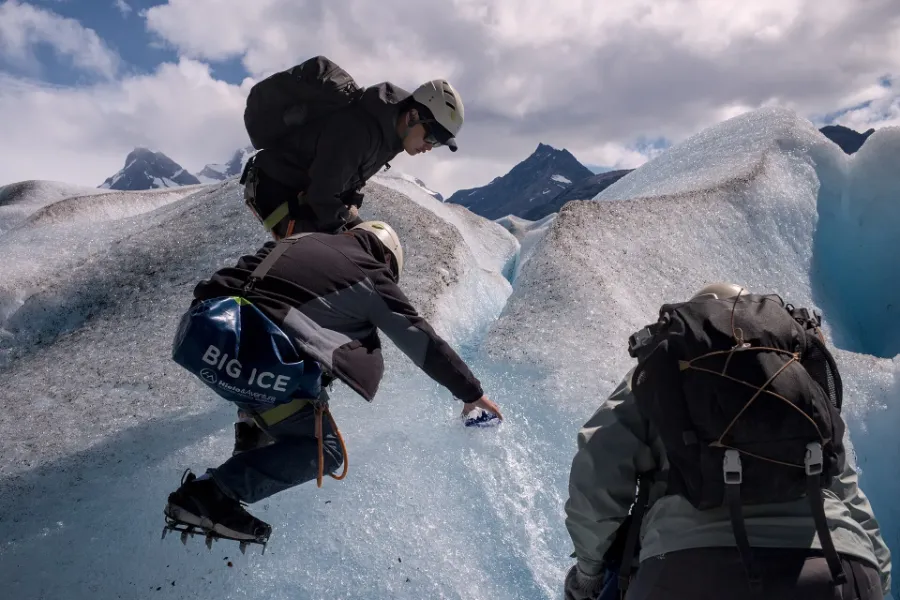
Ice trekking at Perito Moreno is divided into two main categories: “Minitrekking” (roughly 1.5 hours on the ice) and “Big Ice” (up to 3.5 hours on the ice). These tours are highly regulated and include boat transfers across the lake. Because the glacier is so accessible, you can go from your hotel in El Calafate to walking on the ice in under three hours.
- Difficulty: Moderate; involves short boat ride and crampon walking vs. Higher; involves hiking or boat plus a climb to the ice access point.
- Availability: High; multiple departures daily vs. Lower; limited by boat schedules and trekker capacity.
- Min Age: 8 to 65 years for Minitrekking (18-50 for Big Ice) vs. Usually 14 to 65 years for Grey ice hiking.
- Duration: 1.5 to 3.5 hours on ice vs. 2.5 to 3 hours on ice.
Perito Moreno is better for a convenient, high-action trek; Grey is better for those who want a more rugged, less crowded experience.
Kayaking is where Grey Glacier truly shines. While kayaking tours have recently launched at Perito Moreno, they typically take place in the large, open waters of the lake at a safe distance from the face. At Grey Glacier, you can paddle through a labyrinth of icebergs in more sheltered waters, often getting a much closer perspective of the ice’s texture and scale. The experience of paddling in the shadow of the Andes is one of the most sought-after activities in Torres del Paine.
Logistics and Crossing the Border
Many travelers wonder if they can see both glaciers in a single trip. The answer is yes, but it requires crossing the international border between Argentina and Chile, which adds a layer of logistical complexity. The two primary hubs, El Calafate (Argentina) and Puerto Natales (Chile), are separated by roughly 270 kilometers of Patagonian steppe.
The journey between the two towns typically takes about 5 to 6 hours by bus, depending on the speed of the border crossing at Cancha Carrera (Argentina) and Cerro Castillo (Chile). During the peak season (November to March), buses run daily, but they can fill up weeks in advance. If you want to see both, you should budget at least four days: one for Perito Moreno, one for travel, and two for Grey Glacier and Torres del Paine.
Do not forget to check visa requirements for both Argentina and Chile before your trip. While many nationalities receive a 90-day stamp on arrival, some still require pre-arranged visas or reciprocity fees that cannot be paid at the land border.
Choosing your base camp is the next decision. El Calafate is a bustling tourist town with a wide range of hotels and restaurants, designed specifically to service glacier visitors. Puerto Natales is a more rugged port town that serves as the gateway to Torres del Paine. If you are visiting Grey Glacier, you will likely spend at least one night inside the park at a refugio or campsite to avoid a 4-hour round-trip commute from town.
For a broader look at how to split your time between the two countries, our comparison of the Chilean and Argentine sides of the region is a vital resource.
Cost Comparison: Budgeting for the Ice
Visiting these glaciers involves different cost structures. Perito Moreno is generally more expensive in terms of the single-day entry fee but cheaper in terms of overall logistics. Grey Glacier is part of a larger national park system where the costs are often bundled into a multi-day trekking or camping budget.
For the 2026/27 season, the entrance fee for Los Glaciares National Park in Argentina is approximately $45,000 ARS for international visitors. Torres del Paine National Park in Chile requires a park entry ticket purchased via pasesparques.cl: a multi-day pass costs CLP 48,500 and a 1-day pass costs CLP 32,400.
Transportation is the variable that most impacts your budget. A round-trip bus from El Calafate to Perito Moreno is affordable and frequent. To reach Grey Glacier, you must pay for a bus to the park, a catamaran across Lago Pehoé (if hiking), or the dedicated Grey III navigation, which can cost upwards of $100 USD per person.
In summary, a day trip to Perito Moreno is the most cost-effective way to see a world-class glacier. Visiting Grey Glacier is a larger financial commitment because it almost always requires additional transport within a national park that has some of the highest prices in South America.
The Verdict: Which Glacier is Right for You?
The decision ultimately comes down to the “payoff-to-effort” ratio. Perito Moreno offers a massive payoff for very little effort, while Grey Glacier offers a deep sense of accomplishment and wilderness immersion for a significant investment of time and energy.
Choose Perito Moreno if:
- You have limited time (less than 3 days in the region).
- You want to see the dramatic action of ice calving.
- You are traveling with children or individuals with limited mobility.
- You are based in Argentina and don’t want the hassle of a border crossing.
Choose Grey Glacier if:
- You are already planning to hike the W or O Trek.
- You want to kayak among icebergs in a remote setting.
- You prefer wilderness environments over developed tourist sites.
- You are looking for the moody, dramatic landscapes typical of the Chilean fjords.
If you have ten days or more, you don’t have to choose. Seeing both allows you to appreciate the incredible diversity of the Southern Patagonian Ice Field—from the thunderous power of Perito Moreno to the silent, ancient beauty of Grey.
FAQ
Is Perito Moreno or Grey Glacier better for families? Perito Moreno is generally better for families due to its accessible boardwalks and shorter travel time from a major town, whereas Grey Glacier requires significant hiking or a long boat trip.
Can I walk on the ice at both Perito Moreno and Grey Glacier? Yes, both glaciers offer ice trekking tours, but the “Minitrekking” at Perito Moreno is more easily accessible for most travelers than the ice hiking at Grey Glacier.
Which glacier is more likely to show ice calving, Perito Moreno or Grey? Perito Moreno is world-famous for its frequent and dramatic ice calving because of its unique frontal pressure, making it much more likely you will see ice fall there than at Grey Glacier.
How much time do I need to see both Perito Moreno and Grey Glacier? You should budget at least four days to see both, allowing for travel time between El Calafate and Torres del Paine, which includes a border crossing and several hours on a bus.
Is the water at Grey Glacier or Perito Moreno blue? Both glaciers exhibit stunning deep blue ice, but Perito Moreno is often cited for its brilliant sapphire hues, while Grey Glacier’s ice contrasts sharply against the grey, sediment-rich water of Lago Grey.
Do I need a guide to visit Perito Moreno or Grey Glacier? You can visit the Perito Moreno boardwalks independently by car or bus, but you must have a certified guide for any ice trekking or boat tours at either Perito Moreno or Grey Glacier.