Glacier Hiking in Patagonia: 2026 Ice Trekking Guide
Yes, you can walk on glaciers in Patagonia, but it is a strictly regulated activity that requires specialized equipment and certified guides. While the Southern Patagonian Ice Field feeds dozens of massive glaciers, only two primary locations offer safe, legal, and accessible ice trekking: Perito Moreno Glacier in Argentina and Grey Glacier in Chile.
Walking on these ancient rivers of ice is the single most immersive way to experience the scale of the Patagonian wilderness. This guide compares the three main trekking options—Mini Trekking, Big Ice, and the Grey Glacier hike—to help you decide which fits your fitness level, age, and budget for the 2026/27 season.
Can You Walk on Glaciers in Patagonia?
You cannot simply hike onto a glacier in Patagonia on your own. Because glaciers are dynamic, constantly shifting environments filled with hidden crevasses and unstable seracs, access is restricted to guided groups equipped with crampons, harnesses, and helmets.
Most of the ice you see in the region originates from the Southern Patagonian Ice Field. This massive expanse is the world’s third-largest contiguous ice mass outside of the polar regions (Antarctica and Greenland). While you can view many glaciers from a boat or a distance, trekking is concentrated in two hubs: El Calafate (Argentina) for Perito Moreno, and Torres del Paine (Chile) for Grey Glacier.
It is important to note that popular glaciers like Upsala and Spegazzini in Argentina do not currently offer ice trekking tours. These are receding at rates that make the ice edges too unstable for safe foot access. If your goal is to physically stand on the ice, you must narrow your focus to Perito Moreno or Grey.
Perito Moreno: The World’s Premier Ice Trekking Destination
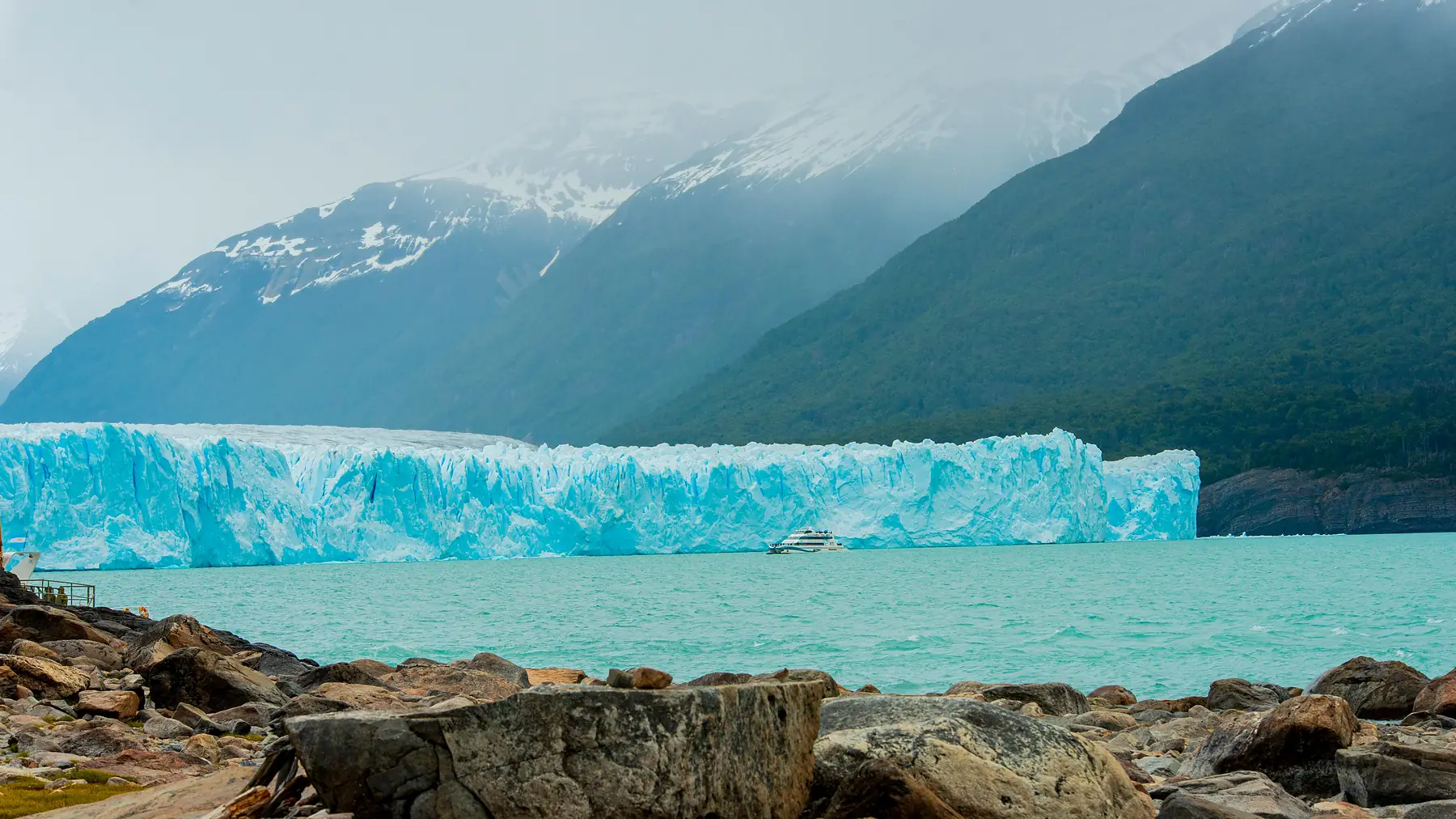
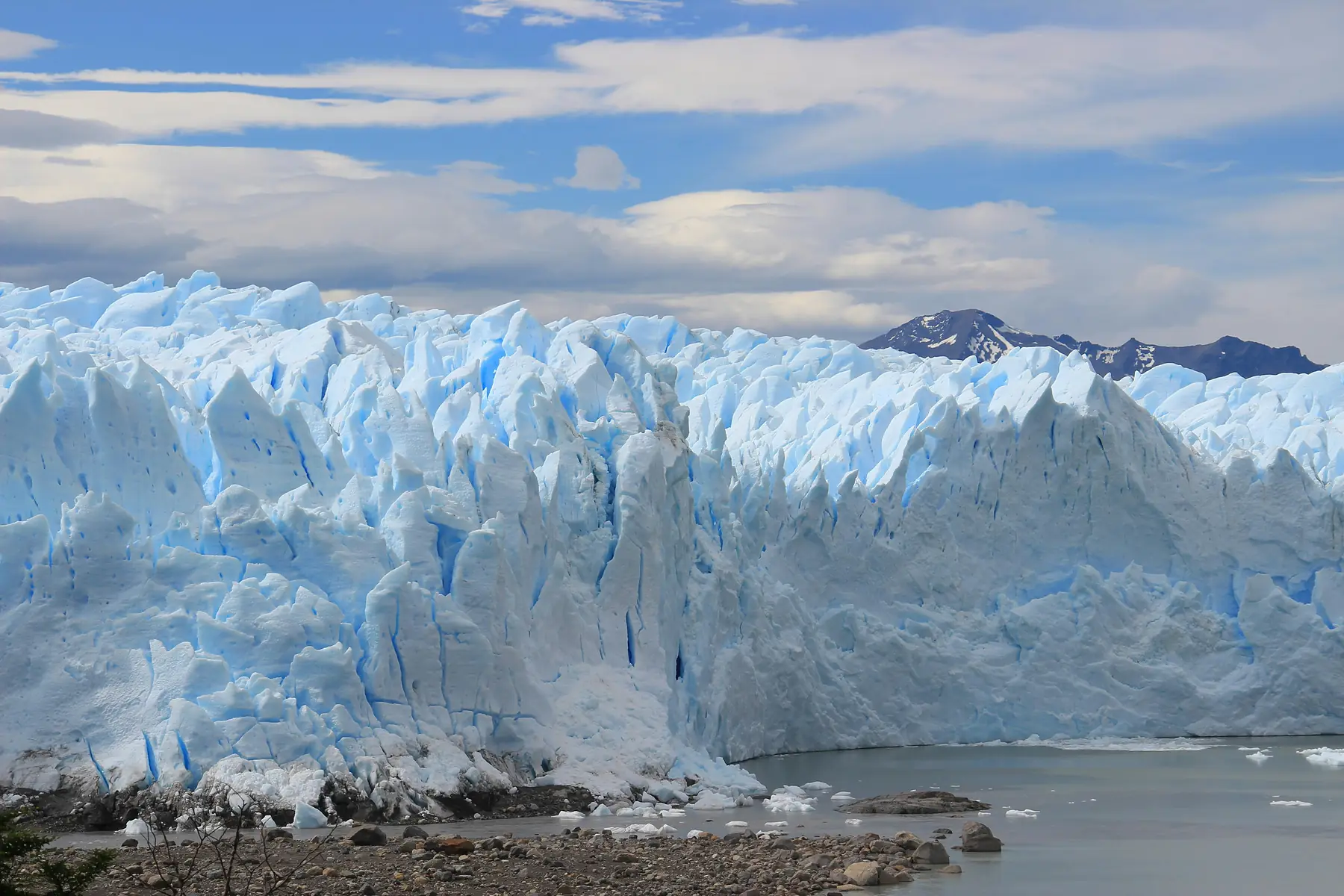
Perito Moreno is the most famous glacier in South America for a reason: it is one of the few glaciers on the planet that is considered to be in a state of equilibrium. Because the ice at the edges remains relatively stable and accessible, it is the primary site for ice trekking in Argentina.
Located 80 kilometers from El Calafate, Perito Moreno covers a staggering 250 square kilometers. The ice wall towers an average of 70 meters (230 feet) above the surface of Lake Argentino. For trekkers, the journey begins at the “Bajo de las Sombras” port, located about 6 kilometers before the main glacier balconies. From here, a short boat ride across the Rico Arm takes you to the base camp where the trekking begins.
If you want to understand the full scope of the glacier beyond the trekking trails, including the famous boardwalks and history, see our comprehensive guide to Perito Moreno.
Mini Trekking vs. Big Ice: Which Perito Moreno Tour is Right for You?
In Argentina, a single operator, Hielo y Aventura, holds the exclusive concession for trekking on Perito Moreno. Whether you book through a third-party site or directly, you will be joining one of two specific programs: Mini Trekking or Big Ice.
The decision between the two usually comes down to two factors: your age and your physical stamina. The “Mini Trekking” is a highlight reel designed for the general traveler, while “Big Ice” is a demanding full-day expedition that reaches the heart of the glacier.
| Criteria | Mini Trekking | Big Ice |
|---|---|---|
| Time on Ice | Approx. 1.5 hours | Approx. 3 hours |
| Age Limit | 8 to 65 years old | 18 to 50 years old |
| Fitness Level | Moderate | High / Demanding |
| Key Sights | Small crevasses, peripheral ice | Blue lagoons, deep moulins, ice caves |
Choose Mini Trekking for a manageable highlight; choose Big Ice if you are fit and want to see deep blue lagoons and ice caves.
Mini Trekking: The Classic Experience
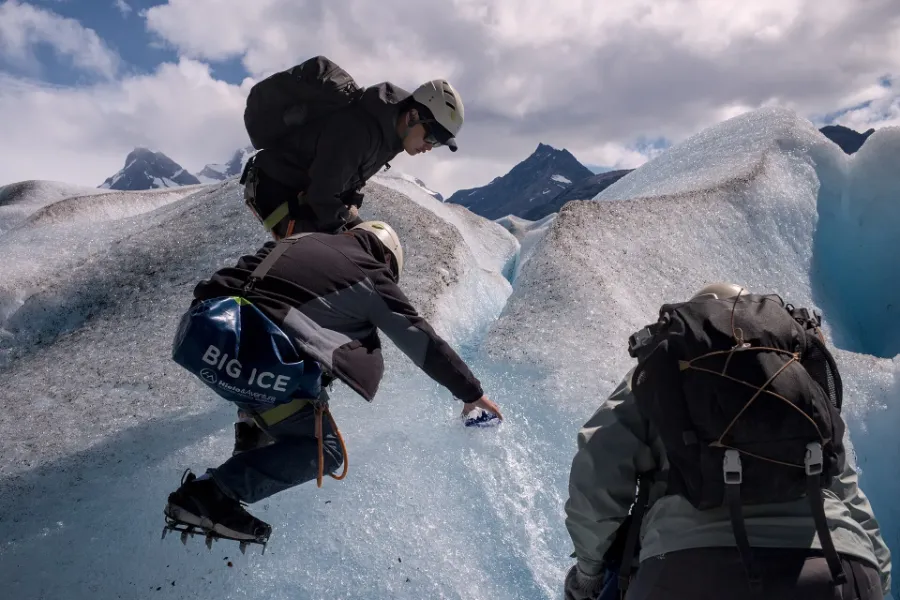
The Mini Trekking tour is the most popular excursion in El Calafate. After a 20-minute boat ride, you take a short hike through a sub-antarctic forest to reach the glacier’s edge. Guides will help you strap on heavy steel crampons before leading you onto the ice for about 90 minutes. You’ll navigate small ridges and see tiny blue streams of meltwater. It is accessible for anyone who can walk for two hours on uneven terrain.
Big Ice: The Deep Dive
The Big Ice trek is a different beast entirely. It requires a much longer approach hike along the lateral moraine (the rocky debris at the side of the glacier) just to reach the entry point. Once on the ice, you spend approximately three hours trekking toward the center of the glacier. This is where you find the “big” features: massive sinkholes (moulins) that disappear into the depths and vibrant blue lagoons that look like swimming pools carved into the crystal.
The age limits for these tours are strictly enforced. As of the 2026/27 season, Hielo y Aventura does not make exceptions for those over 65 on the Mini Trekking or over 50 on the Big Ice, regardless of fitness level.
If you are looking to bundle these treks with other activities in the region, you can explore our glacier tour comparison page.
Glacier Grey Ice Hiking: The Chilean Alternative
While Argentina offers the most famous treks, Chile’s Grey Glacier in Torres del Paine National Park provides a more rugged, “wild” alternative. This trek is operated primarily by BigFoot Patagonia and is a favorite for those already hiking the W Trek or the O Circuit.
The logistics here are more complex than in Argentina. The tour departs from Refugio Grey, which is only accessible by a several-hour hike from Paine Grande or by taking the Grey III navigation boat across the lake. From the refugio, you board a small zodiac boat to reach the “nunataks”—rocky islands peeking out from the ice field.
The Grey Glacier trek typically lasts about five hours in total, with approximately 2.5 to 3 hours spent directly on the ice. Because it is less crowded than Perito Moreno, the experience feels much more like a true expedition. You are more likely to find yourself alone among the towering blue seracs, away from the hum of other tour groups.
For more details on staying at the base for this trek, visit our Grey Glacier hub.
2026/27 Cost Comparison: What to Budget
Glacier hiking is one of the most expensive day trips in Patagonia. The high price reflects the specialized equipment, the high ratio of guides to guests (usually 1:10 or 1:15), and the complex boat logistics required to reach the ice.
For the 2026/27 season, expect the following estimated price ranges in USD:
- Perito Moreno Mini Trekking: $380 - $480 USD
- Perito Moreno Big Ice: $650 - $850 USD
- Glacier Grey Ice Hike: $190 - $270 USD (Note: This does not include the cost of getting to Refugio Grey)
In Argentina, prices are often quoted in Argentine Pesos (ARS). If you pay locally or through certain platforms using the “Blue Dollar” or MEP exchange rate, you can often save significantly compared to the official USD rate. Always check the current exchange landscape before booking.
Note that these prices almost never include the National Park entrance fees. In 2026, the fee for Los Glaciares National Park (Argentina) and Torres del Paine (Chile) must be paid separately, usually online in advance. Additionally, lunch is not provided; you must carry your own food and water in a backpack.
What to Expect: A Step-by-Step Guide to the Ice Trek
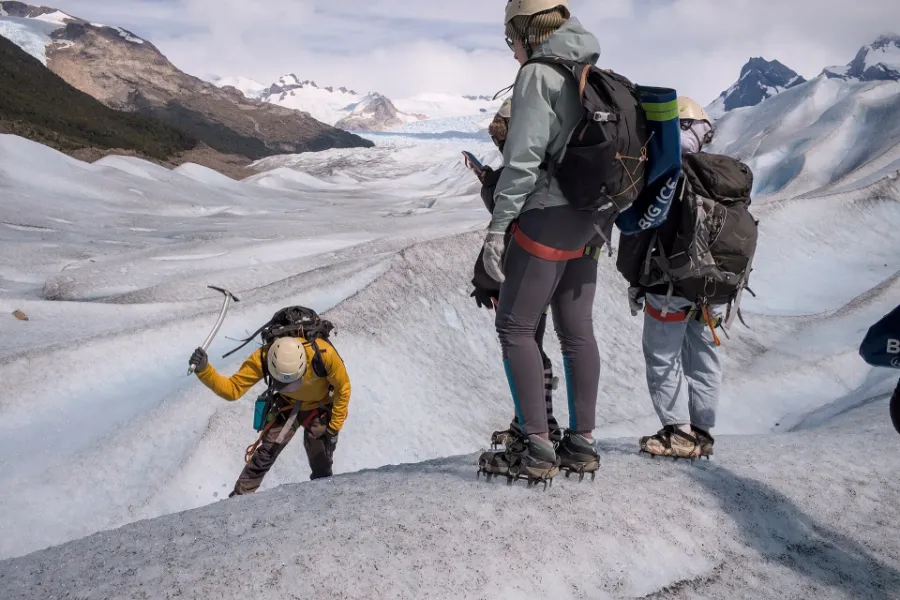
The transition from solid ground to glacier ice is a surreal experience. Once you arrive at the “cramponing” station, guides will fit you with heavy, multi-pointed steel spikes that strap over your hiking boots.
The Cowboy Walk
Walking in crampons is not natural. You cannot roll your foot from heel to toe as you do on a sidewalk. Instead, you must adopt the “cowboy walk”: keep your feet about shoulder-width apart and stomp your feet flat onto the ice so that all the spikes engage simultaneously. When walking uphill, you point your toes outward (the “duck walk”); when going downhill, you keep your knees bent and lean slightly forward, ensuring the spikes bite into the surface.
The Sights and Sounds
A glacier is not silent. As you hike, you will hear the ice “groan” and “crack”—a reminder that the entire mass is flowing toward the water. You will see moulins, which are vertical shafts carved by meltwater that can drop hundreds of feet into the dark heart of the glacier.
Javier, Lead Guide at Perito MorenoThe water you see running in the small streams on top of the glacier is some of the purest on the planet. We encourage trekkers to bring a reusable bottle and fill it directly from the ice. It’s 400-year-old ‘glacier milk’ at its finest.
Most tours conclude with a traditional toast. The guides will chip off a few shards of “thousand-year-old ice” to serve with a glass of whiskey or, in Chile, a pisco sour. It’s a bit of a cliché, but after three hours on the ice, the warmth is welcome.
Essential Packing List for Patagonia Glacier Hiking
The temperature on the ice is consistently 5 to 10 degrees Celsius colder than on the surrounding trails, and the wind off the Southern Patagonian Ice Field can be fierce.
- Hiking Boots: These are non-negotiable. You need a sturdy, over-the-ankle boot with a stiff sole. If your boots are too soft (like sneakers or UGGs), the crampon straps will dig into your feet and likely slip off.
- Gloves: Most operators will not let you on the ice without gloves. This isn’t just for warmth; glacier ice is incredibly sharp. If you trip and put your hand down to break your fall, the ice crystals can slice your skin like glass.
- Category 3 or 4 Sunglasses: The “double sun” effect—direct sunlight plus the reflection off the white ice—is blinding. Without high-quality UV protection, you risk snow blindness.
- Sunscreen: Even on cloudy days, the UV reflection from the ice is intense. Apply more than you think you need, especially under your chin and nose.
Safety and Physical Requirements
Operators are incredibly risk-averse because a rescue on the ice is a logistical nightmare. This leads to the strict age limits mentioned earlier. Beyond age, the primary physical concern is your knees and ankles. The constant “stumping” motion required for crampon walking, combined with the weight of the steel spikes, puts significant strain on the joints.
If you have chronic knee issues or have recently had surgery, the Big Ice trek is likely too much. The Mini Trekking is more manageable, but still requires a high degree of balance.
Weather Cancellations
Patagonia’s wind is the ultimate decider. If sustained winds exceed 80 km/h, the boat transfers to the glaciers are often suspended for safety.
To help you decide on alternatives if the weather doesn’t cooperate, or if you find the physical requirements too daunting, consider these options:
FAQ
QUESTION: How much does glacier hiking in Patagonia cost for the 2026 season? ANSWER: For the 2026/27 season, expect to pay between $380 and $480 USD for Perito Moreno Mini Trekking, while the Big Ice trek typically ranges from $650 to $850 USD. Glacier Grey ice hiking in Chile typically costs between $190 and $270 USD, excluding park entry fees and transport to the refugio.
QUESTION: Is the Perito Moreno Big Ice trek worth the extra cost? ANSWER: For those with high fitness levels, the Big Ice trek is often considered worth the premium as it offers approximately 3 hours on the ice and access to deep blue lagoons and caves that the shorter Mini Trekking tour cannot reach.
QUESTION: What is the minimum age for glacier hiking in Torres del Paine? ANSWER: Most operators for the Grey Glacier ice hike in Torres del Paine, including BigFoot Patagonia, require participants to be at least 12 years old and no older than 65.
QUESTION: Do I need professional mountaineering experience to hike a Patagonia glacier? ANSWER: No, glacier hiking tours on Perito Moreno and Grey Glacier are designed for beginners; guides provide all equipment and teach you the basic “flat-foot” walking technique on-site.
QUESTION: Can I go glacier hiking on Perito Moreno in the winter? ANSWER: Most glacier hiking tours in Patagonia operate from August or September through April or May; tours are generally suspended during the peak winter months of June and July, though some Mini Trekking departures may occur in August depending on conditions.
QUESTION: Are hiking boots required for glacier trekking on Perito Moreno? ANSWER: Yes, sturdy hiking boots with ankle support are mandatory. Soft shoes or sneakers are not compatible with the crampon systems used by operators like Hielo y Aventura.