
W Trek Difficulty: How Hard is the Torres del Paine Hike?
The W Trek is a moderately difficult multi-day hike that requires a solid baseline of cardiovascular fitness but no technical mountaineering skills. While the trail is well-marked and does not involve ropes, crampons, or glacier crossings, the combination of 80 kilometers (50 miles) of trekking, significant elevation changes, and unpredictable Patagonian winds makes it a substantial physical challenge for most hikers.
To complete the full “W” shape, you will likely spend 4 to 5 days on the trail, averaging 6 to 10 hours of movement per day. The difficulty is not defined by a single steep climb, but by the cumulative fatigue of consecutive high-mileage days over rocky, uneven terrain. Whether you find it “hard” depends largely on two variables: your preparation and your pack weight.
The Big Picture: W Trek Difficulty Stats
The W Trek is often described as the “entry-level” multi-day experience in Torres del Paine, especially when compared to the longer and more remote O-Circuit. However, “entry-level” in Patagonia still involves nearly 3,000 meters of total ascent.
W Trek At-a-Glance Stats (2026/27 Season)
- Total Distance: Approximately 80km (50 miles)
- Total Elevation Gain: Approximately 2,730m (8,950ft)
- Duration: 4-5 days
- Daily Hiking Time: 6-10 hours
- Highest Point: Base Torres (approx. 900m / 2,950ft)
- Technical Skill: None (Class 1-2 hiking)
For context on the physical demand, the total elevation gain over the course of the trek is significant.
While the W Trek is significantly easier than the O-Circuit—which includes the steep and often muddy John Gardner Pass—it is much more demanding than standard day hikes found in North American or European national parks. The difference lies in the terrain; you are rarely on a flat, groomed surface.
To understand how these stats translate to the trail and to see the specific path you will follow, you can view our detailed map and elevation guide:
Technical vs. Physical Difficulty: What to Expect
It is important to distinguish between technical difficulty (the skills required) and physical difficulty (the fitness required). The W Trek has a technical rating of zero. There are no sections requiring hands-on climbing, and the trails are wide enough that exposure (fear of heights) is rarely an issue for most trekkers.
The physical difficulty, however, is high. You are asking your body to perform at a high level for several days in a row. This endurance requirement is compounded by the “Patagonian factor” of relentless wind and rapid temperature shifts, which drain your energy faster than hiking in stable conditions.
The Pack Weight Variable
Your choice of accommodation is the single biggest factor in how hard the W Trek feels.
- Refugio-to-Refugio: If you stay in refugios and opt for full-board meals, your pack weight will likely stay between 5-7kg (11-15 lbs). This turns the trek into a series of challenging day hikes.
- Camping: If you carry a tent, sleeping bag, stove, and food, your pack will weigh between 12-18kg (26-40 lbs). Carrying this weight over the moraine (rocky glacial debris) in the French Valley significantly increases the strain on your knees and ankles.
For more information on the general fitness standards expected for Patagonia, you can review our broader guide:
Section-by-Section Difficulty Breakdown
The “W” is comprised of three vertical “legs” and two connecting horizontal sections. Each leg presents a different type of physical stress.
Leg 1: Base Torres (The Eastern Flank)
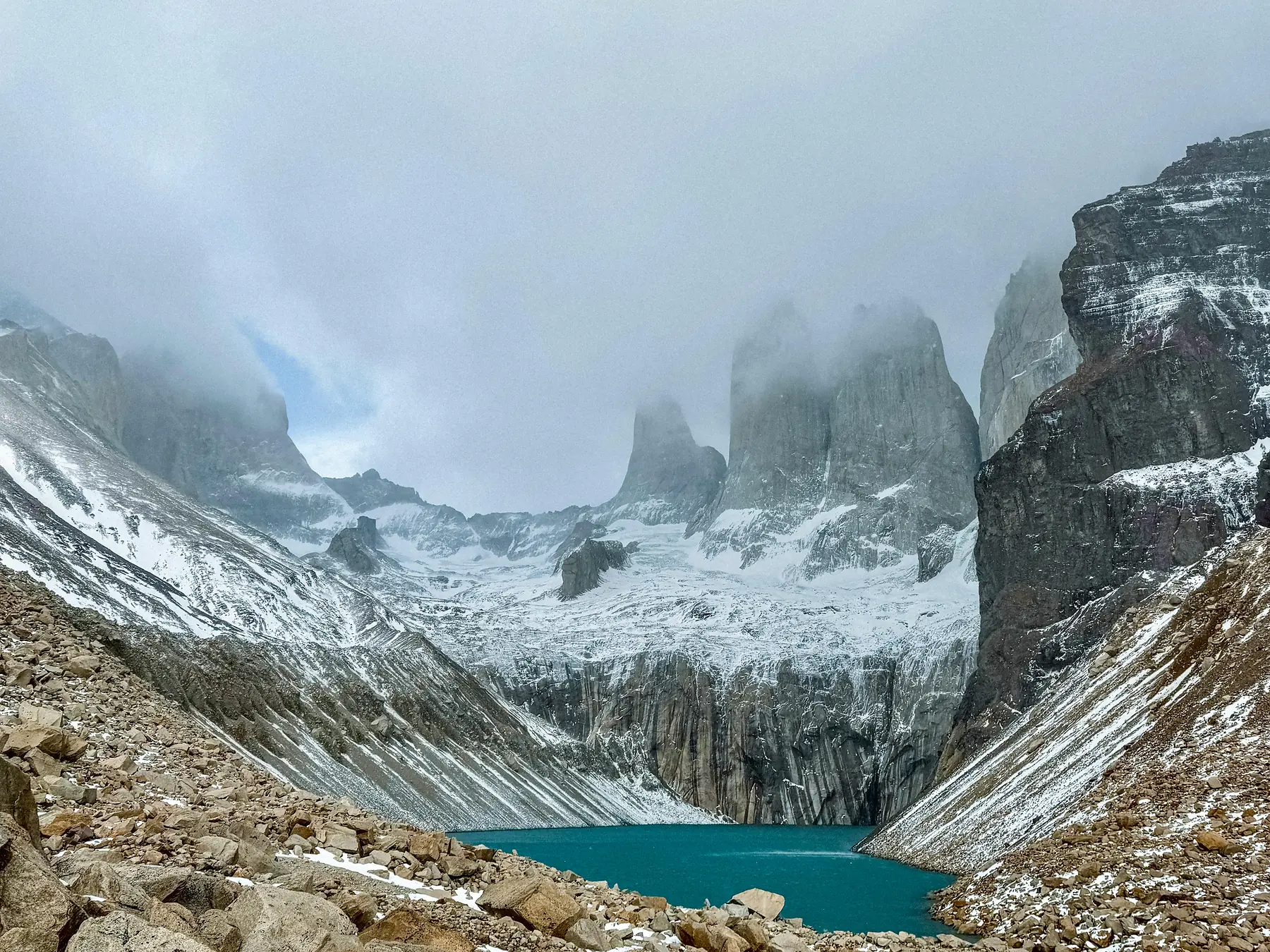
This is often the first or last day of the trek and is widely considered one of the most taxing. The climb starts with a steady, steep ascent to “Windy Pass,” where you are fully exposed to the elements. The final 45 minutes involve a steep scramble over large boulders to reach the Mirador Las Torres. This section requires high cardiovascular output and careful foot placement on the descent to avoid knee strain.
Leg 2: The French Valley (The Middle)
The difficulty here is defined by the terrain rather than just the gradient. The trail into the valley is a mix of forest roots and loose rock. The climb to Mirador Británico is sustained and steep, but the real challenge is the descent. Walking back down through the moraine requires constant micro-adjustments of the ankles, which can lead to significant fatigue by the end of the day.
Leg 3: Grey Glacier (The Western Flank)
While this section has less total elevation gain than the other two, it is far from flat. The trail consists of “rolling” hills—constant short, steep climbs followed by immediate descents. This repetitive motion can be surprisingly tiring, especially if you are hiking against the wind as you head toward the glacier.
To see how these sections fit into a standard 5-day plan, including where you will sleep each night, refer to our daily breakdown:
The Hardest Day: Mirador Las Torres vs. French Valley
Most hikers debate which day is the “crux” of the W Trek. The answer usually depends on whether your body struggles more with steep gradients or uneven terrain.
- Distance: 18-22km round trip vs. 18-20km round trip
- Elevation Gain: ~900m vs. ~600m
- Terrain: Steady trails followed by a boulder scramble vs. Constant rocks, roots, and uneven moraine
- Primary Strain: Lungs and heart on the way up; knees on the way down vs. Ankle stability and cumulative leg fatigue
The French Valley is often physically harder due to the terrain, while Base Torres is more cardiovascularly demanding.
There is also a “hidden” hardest day for those on a tight schedule: the trek from Paine Grande to Grey Glacier and back in a single day to catch the afternoon catamaran. This covers nearly 30km of rolling terrain and is the most common cause of “trail burnout” on the W.
Terrain Analysis: What’s Underfoot?
In Patagonia, the surface you walk on is just as important as the incline. The W Trek features three primary terrain types that contribute to its difficulty.
The Boulders and Scree
Near the high points of the W—specifically the final push to the Towers and the upper French Valley—the trail disappears into fields of boulders. You aren’t “climbing,” but you are stepping up and over large rocks. This requires more energy than a flat path and places high demand on your quadriceps.
Forest Mud and Exposed Roots
In the lower sections of the French Valley and near Refugio Los Cuernos, the trail winds through lenga forests. Here, the challenge is mud and a lattice of exposed tree roots. These become incredibly slick when wet, making every step a potential slip hazard. This constant “active” walking is mentally tiring.
The “Patagonian Flat”
You will often hear guides refer to sections of the trail as “Patagonian Flat.” This is a local joke. It means the trail is not climbing a mountain, but it is also never level. It is a series of 5-meter climbs and 5-meter drops that prevent you from finding a consistent rhythmic stride.
Trekking poles are not a “luxury” on the W Trek; they are essential equipment. They reduce the impact on your knees by up to 25% on descents and provide two extra points of contact when the wind tries to push you off balance.
Can a Beginner Hike the W Trek?
Yes, a beginner can hike the W Trek, provided “beginner” refers to trekking experience rather than physical fitness. If you have never spent four days in the wilderness but you are an active runner, cyclist, or gym-goer, you will likely find the trek manageable.
The W Trek is an ideal “first multi-day hike” because of the infrastructure. By staying in refugios, you remove the two hardest parts of traditional trekking: carrying a heavy pack and setting up camp in bad weather.
However, if you have zero baseline fitness, the W Trek will be a struggle. You should be able to walk for 6 hours on hilly terrain before arriving in Puerto Natales.
If you are concerned that the full W Trek might be too much for your current fitness level, you can explore easier day-hiking alternatives in the park:
If you are ready to commit but want to ensure you are physically prepared, we have a specific training guide for this route:
The “Hidden” Difficulty: Patagonian Weather
You cannot talk about W Trek difficulty without talking about the wind. The physical effort required to walk increases exponentially when you are fighting a headwind.
Patagonian winds can reach sustained speeds of 60-80 km/h, with gusts exceeding 100 km/h. Walking against these winds can add 20-30% more time to your day and significantly increase your caloric burn.
The weather adds difficulty in three ways:
- Resistance: Leaning into a 70 km/h wind for four hours is a core and leg workout in itself.
- Temperature Drain: The “four seasons in one day” phenomenon means your body is constantly working to regulate its temperature as you sweat through a climb and then freeze at a windy viewpoint.
- Technicality: Rain turns the boulder sections into slippery hazards, requiring much slower, more deliberate movement that extends your time on trail.
If the physical challenge feels intimidating, many hikers find that hiring a guide helps manage the mental and physical load of navigating the weather and terrain:
FAQ
QUESTION: Is the W Trek in Torres del Paine hard for seniors? ANSWER: The W Trek is achievable for active seniors with good knee health, provided they use trekking poles and opt for the Refugio-to-Refugio “light pack” style to minimize physical strain. Many seniors find that taking an extra day to complete the trek allows for a more manageable pace.
QUESTION: What is the hardest part of the W Trek in Patagonia? ANSWER: Most hikers find the final boulder scramble to the Base of the Towers (Mirador Las Torres) the hardest part due to the steep gradient and uneven, rocky footing. This section requires the most cardiovascular effort and concentration.
QUESTION: Do I need to worry about altitude on the W Trek? ANSWER: No, altitude is not a significant factor on the W Trek; the highest point is only around 900 meters (2,950 feet), which is well below the threshold for altitude sickness. You can focus entirely on your physical endurance rather than oxygen levels.
QUESTION: Can I hike the W Trek with no experience? ANSWER: Yes, you can hike the W Trek with no prior multi-day experience as the trails are well-marked and non-technical, but you must have a solid baseline of cardiovascular fitness. Staying in refugios is highly recommended for those without previous camping experience.
QUESTION: How much elevation gain is on the W Trek? ANSWER: The total elevation gain for the standard 5-day W Trek is approximately 2,730 meters (8,956 feet), spread across several significant climbs into the park’s valleys. The most concentrated gains occur on the legs leading to the Towers and the French Valley.
QUESTION: Are trekking poles necessary for the W Trek difficulty? ANSWER: While not mandatory, trekking poles are highly recommended to manage the steep, rocky descents and to provide stability against the famous Patagonian winds. They are the most effective tool for preventing knee pain and fatigue on the trail.